Introduction
The course is designed and led by the Asfari Foundation, in collaboration with the Asfari Institute for Civil Society and Citizenship, the London School of Economics and Political Science (LSE), and Ahel Organization. Together, these institutions bring a powerful combination of academic rigour, regional expertise, and practical experience in civil society leadership, advocacy, and community organising.
This year’s programme is delivered in partnership with the Open Society Foundations (OSF) and the Ford Foundation.
The course will develop participants’ political analysis and influencing skills through discussions of heuristics, frameworks, and case studies. This will be achieved through a combination of in-person teaching sessions, facilitated activities, and peer-to-peer learning opportunities; a bespoke multimedia library of learning materials; and online coaching sessions. The curriculum moves from theory and frameworks for thinking, to practical skills and tools for designing effective influencing strategies.
The course responds to an identified need to assist civil society in the region to refocus on advocacy, challenging the status quo, and seeking transformative change—especially after years of donor funding that has concentrated largely on humanitarian response and service delivery. Throughout the programme, emphasis will be placed on contextualising the content with relevant case studies and lived experiences, and on sharing and building on the knowledge of participants.
By the end of the course, each participant will have developed their own influencing strategy under the guidance of experienced facilitators.
The most promising strategies will be considered for funding by the Asfari Foundation.
The Team
The Asfari Foundation leads the design and delivery of the Certificate in Influencing and Political Acumen (CIPA), bringing together academic excellence and civil society expertise to support emerging leaders and organisations in the Levant. With a long‑standing commitment to civic empowerment, leadership development, and strategic advocacy, the Foundation guides the programme to ensure that participants are equipped with the analytical tools, practical frameworks, and regional insights needed to influence change effectively.


The Foundation works in close partnership with a set of distinguished collaborators:
The Asfari Institute for Civil Society and Citizenship at the American University of Beirut serves as a regional hub dedicated to strengthening civil society across the Arab region. It supports knowledge production and dissemination, and creates inclusive spaces for learning, networking, convening, and collaboration. The Institute’s work aims to serve communities from all social strata and gender identities, including, but not limited to, Lebanese citizens, refugee communities, and migrant domestic workers.
The London School of Economics and Political Science (LSE) is one of the world’s leading social science universities, renowned for its research and teaching in political science, public policy, and international development. LSE contributes academic rigour and global perspectives that enrich the programme’s theoretical foundations and equip participants with robust analytical frameworks for understanding complex political environments.
Ahel Organization is a civil society organisation based in the Levant region that supports people striving for change by organising their collective power and leadership to achieve justice in their causes. Ahel accompanies and coaches grassroots campaigns, teaches participatory leadership and community organising practices through workshops and courses, and connects leaders. Its work focuses on building people power, strengthening collective leadership, and enabling leaders to organise and pursue change with strategic purpose and shared values.
Together, this team ensures that CIPA is both deeply rooted in regional civic practice and informed by global academic knowledge, offering a transformative learning journey for civil society practitioners across the Middle East and North Africa.
Participants
The course will invite pairs of senior leaders and middle management staff from selected organisations to participate together. This will enable the skills imparted by the course and experiences shared by participants to permeate different levels of the participating organisations. It will also support candid discussions of what is possible in different contexts and across different issue areas and ensure the sustainability of the lessons learned.
Learning Objectives
Participants will acquire a combination of practical and analytical skills, backed up by useful knowledge of relevant issues. The course will also aim to reinforce a set of progressive attitudes on how to bring about change.
Practical Skills:
Leadership skills (the ability to delegate, inspire and communicate effectively to maximize impact).
Networking skills (ability to use personal communication, relationship management and professionalism, as a means of building connections with others)
Mobilization skills (ability to engage different stakeholders)
Policy analysis and research skills (ability to create, analyse, or interpret information and develop arguments)
Communication skills (ability to discuss and debate issues respectfully and productively through the use of use of social media, online petitions, community organizing, direct action, and advocacy messaging)
Analytical Skills:
Enhanced critical thinking skills (ability to analyse and evaluate issues and policies)
The ability to analyse problems and processes in order to identify promising points of entry and windows of opportunity for influencing strategies
The use of different techniques to understand the range of different types of power (visible, hidden etc) involved in either achieving or blocking a particular influencing strategy
The use of stakeholder mapping to understand the opportunities and constraints on particular decision makers, and thus build a bridge to a viable change strategy.
Knowledge:
Understanding of political, social, and economic systems and structures and the ways they affect the issues being advocated for
Knowledge of a range of advocacy and influencing tactics and strategies, including grassroots organizing, lobbying, coalition-building, and media outreach
Familiarity with human rights frameworks, principles, and standards relevant to the issue being advocated for
Review the evolution of civil society and activism in the region.
Establish a network of advocates from different areas of expertise who can lobby for common goals.
Increased knowledge around the importance of diversity and inclusion in institutions, policies, and society
Positive Attitudes:
Remain accountable to their communities and connected to needs on the ground.
Ethical and professional conduct, including transparency, accountability, and respect for diversity and human rights.
Increased empathy and understanding towards the needs and experiences of the communities
A more nuanced understanding of different issues and the ways in which they intersect with other forms of oppression and discrimination, and being able to communicate and raise awareness around gender-related issues within communities
Reflexivity, using their own lived experiences to reflect, recognize and address gendered and other biases within their immediate circles as well as within the public domain
Course Structure
Online Module 1: The State–CSO Relationship & Pathways to Influence
Provide a deeper exploration of the state–CSO relationship, including power dynamics, institutional incentives, and barriers to engagement.
Illustrate how NGOs can shift from service delivery to influencing and shaping policies, legislative agendas, and public discourse.
Present regional examples of NGOs that successfully navigated political contexts and used evidence, networks, and coalitions to influence policy.
Introduce the concept of political acumen, understanding systems, actors, timing, and leverage points.
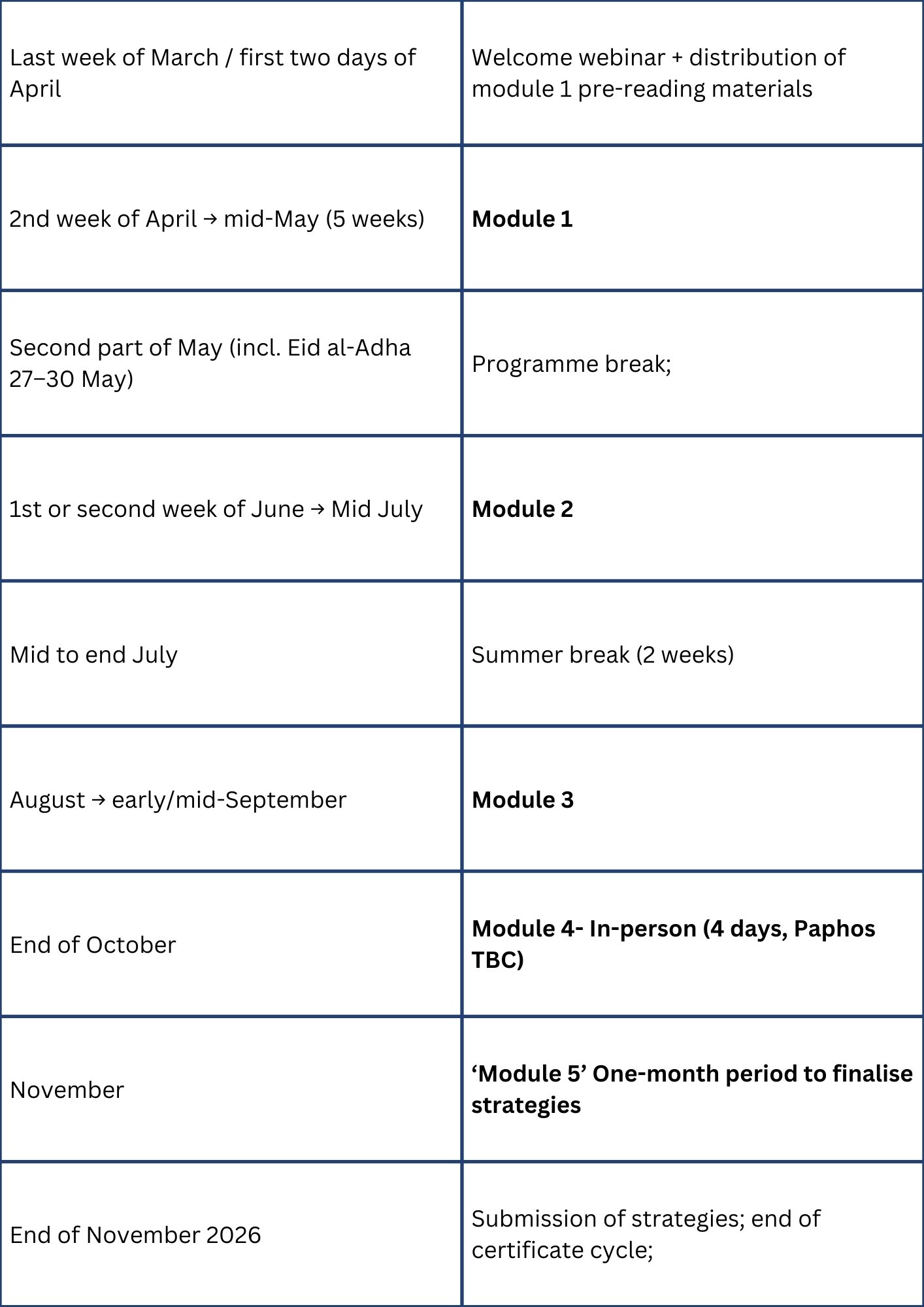
The curriculum will comprise four distinct modules: three online modules, followed by one in- person five-day at AUB Paphos (TBC). These will be followed by an extended period of online mentoring as participants develop strategies with their organizations, with the option of submission to the Asfari Foundation for funding. All online sessions will be recorded for those who cannot attend and wish to catch up afterwards. To support their development, participants will have access to a bespoke online multimedia library of learning materials that delve deeper into core skills, issues and case studies explored by the curriculum.
Online Module 2: Key concepts in influencing
Power, systems and social norms
Analysis and Problem Identification
Public and Private Influencing/ insider and outsider advocacy
Online Module 3: Organizing for Influence: Power, Leadership, and Community
This module introduces the principles and practices of community organising as a pathway to influence. Participants will explore how leadership, power, and participation operate within their institutions and campaigns, and how to activate collective power for social change.
Through a combination of reflective and practice-oriented sessions, participants will examine internal structures, culture, and roles; apply organising tools such as public narrative, power mapping, and relationship-building; and connect these to their organisational strategies.
Assignments between sessions will help participants analyse their institutions and apply practical tools to strengthen leadership, engagement, and influence from within.
In-person module 4: Creating an influencing strategy
The days will be split into morning and afternoon sessions, with coffee breaks.
· Day 1 – Introductions. Sharing work challenges and priorities, on the basis of which we will identify 3 or 4 working groups on common elements. These groups will then constitute the peer groups for working on participants’ personal projects.
· Day 2 – Public, private and online influencing skills, and applying these to participants’ personal projects
· Day 3 – Influencing states, the international system and societies and applying these to participants’ personal projects
· Day 4 – Advocacy, Campaigning and social accountability and applying these to participants’ personal projects
· Day 5 – Wrap up: designing an influencing strategy. Simulation Game to leave on a high note, as well as consolidate the learning from the week
Online module 5: Participants’ influencing strategies
Participants will be aided in developing influencing proposals with their organizations to create change in their own contexts. Course participants will have the opportunity to meet with course conveners twice over this period for one hour to discuss the development of their influencing proposals. They will also be able to book time with conveners to discuss aspects of their work beyond their proposals. Here, conveners will act as ‘critical friends’, providing an opportunity to candidly discuss ongoing challenges or ideas. At the end of the course, selected proposals will be awarded grants to support their planned activities.
Selection Criteria
Location and Theme: Civil society organisations (CSOs) in Syria, Lebanon, Palestine, or Jordan, working in any field, are eligible to apply.
Diaspora Organisations: Syrian CSOs in the diaspora are eligible to apply.
Registration Status: Civil society groups that are not formally registered may apply and participate in the programme, but may not be eligible to apply for funding following the completion of their Influencing Strategies.
Size of the Organisation: Priority will be given to small and medium-sized organisations, defined as those with an average annual budget of between £100,000 and £750,000
English Language Ability: The ability to communicate in English is required. However, participants may develop their Influencing Strategies in Arabic.
Time and Commitment: The course requires a high level of commitment, preparation, and consistent attendance. Applicants must be able to dedicate several hours per week to each online module and attend the in-person module for four full days. Failure to commit to the course schedule will result in disqualification from both the course and eligibility for the associated grant.
Funding Disclaimer: Acceptance into the CIPA Programme does not guarantee subsequent grant funding from the Asfari Foundation.
Programme Timeline